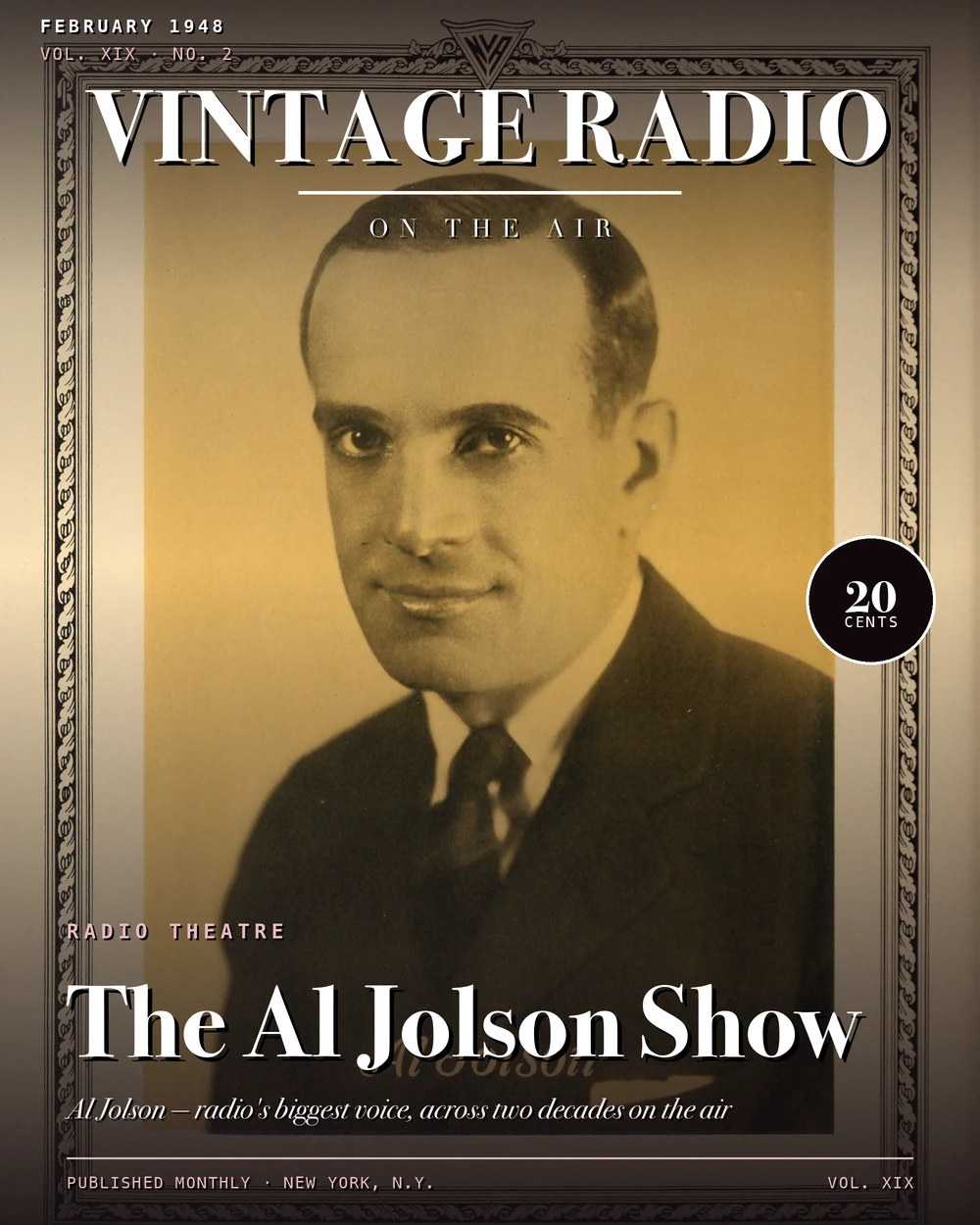
The Al Jolson Show
The Man Who Was Bigger Than Any Title
Al Jolson spent nearly twenty years on radio across a string of programs for different sponsors and different networks, and he never needed a consistent title because the audience kept the ledger for him. Whether the show was called Presenting Al Jolson, Shell Chateau, The Lifebuoy Program, or The Kraft Music Hall, listeners simply thought of it as the Jolson show. That informal ownership of a brand — the performer as the only thing that mattered — tells you more about what Jolson was than any description of his format could.
His roots were deep in vaudeville. Born Asa Yoelson on May 26, 1886, the son of a Russian rabbi, Jolson had reportedly considered becoming a cantor before finding his way to performing. He became a specialist in blackface vaudeville, known for a down-on-one-knee delivery of what contemporaries called robust southern songs. By 1909, when he first sang "Mammy" from a San Francisco stage, his popularity was already growing fast. In 1927 he starred in The Jazz Singer, described at the time as the world's first talking picture, and he was doing guest work on radio as early as 1928.
How the Runs Actually Went
The first regular series, Presenting Al Jolson, debuted on NBC on November 18, 1932, on Fridays at 10 p.m. in a 30-minute slot sponsored by Chevrolet. Ted Fio Rito led the orchestra. It ran through February 24, 1933 — a brief stint, but it established the model.
From August 1933, Jolson joined Paul Whiteman's Kraft-Phenix Program on NBC, a 60-minute Thursday slot that had started in June of that year and would eventually become the long-running Kraft Music Hall. Jolson's appearances were erratic during this period, full of absences. He was gone by August 1934, and the program continued without him — later thriving with Bing Crosby as its star.
The more substantial run came from April 6, 1935, when Jolson took over Shell Chateau on NBC, Saturdays at 9:30 p.m. for 60 minutes, sponsored by Shell Oil. Victor Young led the orchestra. The director was Herb Polesie and the writer-producer was Carroll Carroll, both from the J. Walter Thompson advertising agency. The theme was "Golden Gate." Carroll described the creation of Shell Chateau in his 1970 memoir, None of My Business, noting that the show's title itself required some effort: Shell Oil wanted its name front and center, and Carroll was the one who arrived at "Shell Chateau." There was apparently some concern about how Jolson would pronounce the word chateau when the time came. The format was systematic — greetings, a warmup and song by Jolson, a comedy act, another song, a singing guest, more music, a station break, a dramatic skit, and a final Jolson number. Guests included John Barrymore, Lionel Barrymore, Bette Davis, Ginger Rogers, Joe Penner, and "Slapsie" Maxie Rosenbloom, with Dixie Lee appearing as a singing guest and Judy Garland turning up twice in a single month in 1935. Jolson left before the season ended, and Shell Chateau tried to continue with Wallace Beery and Edward Everett Horton in the host's seat. It was swamped in the ratings almost immediately, which settled any question about who the real draw had been. The show finally left the air on June 26, 1937.
The CBS run for Lever Brothers began December 22, 1936, in a 30-minute Tuesday slot at 8:30 p.m. It cycled through three titles — The Lifebuoy Program, then The Rinso Program, then The Tuesday Night Party — while keeping essentially the same format. Harry Einstein played his Parkyakarkus character as co-star, Martha Raye was also on board, and the announcer was Tiny Ruffner. Music came from Lud Gluskin and Victor Young. This was Jolson's longest regular radio stint, musically interesting if weak on comedy. Jolson again left before the end; Dick Powell picked up the host slot on March 21, 1939, followed by Walter O'Keefe, and the series ended December 12, 1939.
The Colgate Program and the Woolley Pairing
Jolson returned to CBS from October 6, 1942 to June 29, 1943, in a series sponsored by Colgate. The 30-minute Tuesday show was produced by William A. Bacher and directed by Bill Lawrence. Jo Stafford was the vocalist, and Gordon Jenkins and Ray Bloch split orchestra duties. The co-star was Monty Woolley, the ex-Yale professor turned actor who had turned a single guest appearance into a regular role — Bacher is credited with first spotting the on-air chemistry potential of the pairing. Writers put the lowbrow Jolson against the highbrow Woolley and played the tension for laughs. On one broadcast Woolley told Jolson: "If you give your brain to the Smithsonian, I'll give them a magnifying glass." Of all the Jolson series, this is the one that holds up best on its own merits — the pairing gave the comedy an actual spine rather than the looser variety-act structure of earlier programs.
By the early 1940s Jolson's career had been fading. The Colgate Program caught him mid-slump, which makes the quality of the Woolley material more notable. What reversed the slide was a film, not a radio series.
The Jolson Story and the Kraft Music Hall Return
In 1946, Columbia Pictures released The Jolson Story, with Larry Parks playing the young Jolson but Jolson's own voice on the soundtrack. The film brought Jolson back to wide public attention with enough force that radio guest spots became a joke among other comedians — he was everywhere. A sequel, Jolson Sings Again, followed in 1949. Both films were dramatized on The Lux Radio Theater with Jolson playing himself.
Bing Crosby had departed The Kraft Music Hall over a format dispute, and in October 1947 — thirteen years after he had last appeared on the program — Jolson returned as host. The setup was NBC on Thursdays at 9 p.m., 30 minutes, sponsored by Kraft Foods. Ken Carpenter was the announcer and Lou Bring led the orchestra. The theme was "April Showers." Oscar Levant — already familiar to radio audiences from his sharp-tongued turns on Information Please — came on as Jolson's co-star, and his dry wit added considerably to the show for listeners who appreciate that register of humor. Variety's October 8, 1947 review of the premiere ran under the headline "Jolson: Kraft On High" and declared the show had "bounced back into major league programming," calling it "a wham of a show." The three-way comedy exchanges among Jolson, Levant, and Charlie McCarthy on the opening broadcast — Edgar Bergen's dummy was the first night's guest — drew particular notice. This final Kraft run lasted through May 26, 1949, with the running gags centering on Jolson's limited formal education, his advancing age, and his many marriages.
This 1947–49 series is the one to start with for modern listening, and many episodes survive in good fidelity. The earlier eras — from the 1934 Kraft appearances onward — are also represented in surviving recordings.
Jolson died on October 23, 1950, about a year after the series ended — felled by a heart attack at the St. Francis Hotel in San Francisco after a punishing run of 42 shows in 16 days entertaining troops in Korea. Defense Secretary George Marshall posthumously awarded him the Medal for Merit for that service.
What Holds Up and What Doesn't
The programs are uneven, and it's worth being honest about that. Shell Chateau is historically important but tired and dated in format. The Lifebuoy Program gets credit for its music but not much for its comedy. The 1947–49 Kraft Music Hall comes off best — helped significantly by Levant's presence and the lift Jolson was still carrying from the Jolson Story revival. Jolson's material also fell out of favor for a period because of the "darky" lyrics associated with his blackface work, a piece of context worth knowing when approaching the earlier broadcasts.
Across all of it, the through-line is a performer who was genuinely hard to replace. Every time Jolson left a series early, the ratings told the same story. Shell Chateau collapsed. The Lever Brothers show shuffled through two replacement hosts before giving up entirely. The era's sponsors and networks kept coming back to him, and the audience kept following wherever the name appeared. That's a consistent pattern across nearly two decades of radio, and it speaks for itself.